
The Ultimate Guide for First-Time Buyers and Growing Operators
Imagine investing $4,000 in a vending machine—only to discover that the machine was never the real problem.
You compare prices, read reviews, watch videos, and finally choose a machine that seems to check every box. A few weeks after installation, however, sales are lower than expected. Popular products sell out too quickly, slow-moving items occupy valuable shelf space, and every restocking trip takes more time than planned.
At that point, many people begin questioning their investment.
But the machine itself usually isn’t the problem.
The real problem started much earlier—with the buying decision.
Most first-time buyers ask one question:
“Which vending machine should I buy?”
Professional operators ask a completely different one:
“What kind of vending business am I trying to build?”
That single shift in thinking changes everything.
After helping b
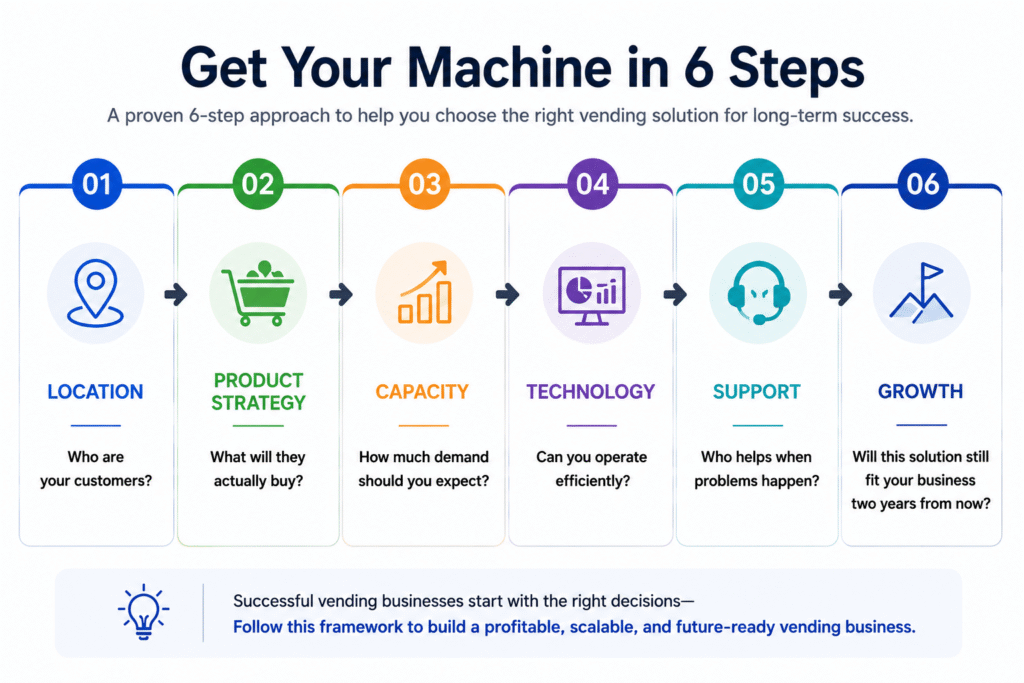
Notice something?
The machine itself doesn’t appear until the middle of the process.
That’s because successful vending businesses aren’t built by buying equipment.
They’re built by making the right business decisions first.
Let’s look at each step.
Step 1 — Start With the Location, Not the Machine
Every vending machine serves a location.
But every location behaves differently.
A machine inside an office serves employees who follow predictable schedules.
A factory may experience intense demand during shift changes.
A university campus sees different buying patterns throughout the day.
A hotel lobby serves guests with completely different purchasing habits than a residential apartment.
That’s why professional operators never ask,
“Which machine sells the most?”
Instead, they ask,
“Who will use this machine every day?”
Before comparing equipment, answer these questions:
“How many people pass the location daily?”
“When are the busiest hours?”
“How long do customers usually stay?”
“Are purchases driven by convenience, necessity, or impulse?”
“Understanding customer behavior first makes every decision that follows much easier.”
Remember:
A vending machine doesn’t create demand.
It simply serves demand that already exists.
Step 2 — Build Your Product Strategy First
Once you understand your location, the next question isn’t machine size.
It’s product selection.
Many first-time buyers assume every vending machine sells the same products.
In reality, different environments create completely different buying habits.
Office employees often purchase bottled drinks, coffee, snacks, and grab-and-go meals.
Gym members typically look for protein drinks, sports beverages, and healthier snack options.
Factories generate consistent demand for larger beverages and convenient meals during shift breaks.
Residential communities often combine drinks and snacks with daily essentials.
Frozen food businesses require an entirely different operating model.
Your products determine how much storage you need.
They influence restocking frequency. They affect customer spending.
And ultimately, they determine which machine is right for your business.
Professional operators never force products to fit a machine.
They choose a machine that fits their products.
Step 3 — Capacity Should Follow Demand
One of the most common buying mistakes is assuming that bigger is always better—or that smaller always saves money.
Neither is true.
The right capacity depends entirely on expected demand.
A machine that’s too small sells out quickly, requiring more replenishment visits and creating missed sales opportunities.
A machine that’s too large ties up unnecessary capital in equipment and inventory.
Instead of asking,
“What’s the biggest machine available?”
Ask,
“What’s the most efficient machine for this location?”
Efficiency—not size—is what drives long-term profitability.
Think Beyond Your First Location
Many entrepreneurs focus on opening one successful location.
Experienced operators think about opening ten.
Before making a purchase, ask yourself:
“Can I monitor inventory remotely?”
“Can I update pricing without visiting every machine?”
“Can multiple machines be managed from one platform?”
“Can I expand into frozen products later?”
“Will this system still support my business as it grows?”
“Buying your first machine isn’t just about today.”
It’s about choosing a solution that can continue supporting your business as it expands.
The best investment isn’t necessarily the lowest-priced machine.
It’s the one that helps you build your next location—and the one after that.
Don’t Compare Machine Price. Compare Revenue Potential.
One of the biggest misconceptions about buying a vending machine is believing that the lowest price offers the best value.
In reality, a vending machine isn’t simply a piece of equipment—it’s a long-term business asset.
The purchase price is paid once.
The operating costs—and the revenue it generates—continue for years.
That’s why experienced operators rarely ask:
“Which machine is the cheapest?”
Instead, they ask:
“Which machine will generate the strongest return over the next five years?”
That simple shift in perspective separates successful operators from everyone else.
A Lower Price Doesn’t Always Mean a Better Investment
Imagine two operators opening similar vending businesses.
The first purchases a machine for $4,000.
The second invests $5,500 in a larger AI-powered model.
Initially, the first operator appears to save $1,500.
But after several months, the picture changes.
The smaller machine runs out of popular products more often.
Additional replenishment trips increase labor and transportation costs.
Stockouts lead to missed sales.
Meanwhile, the larger machine continues serving customers with fewer interruptions, requiring fewer service visits and maintaining more consistent sales.
Although it cost more upfront, it delivers greater value over time.
The lesson is simple:
A cheaper machine isn’t always the more profitable machine.
Think Like an Investor, Not a Shopper
Professional operators don’t focus on discounts.
They focus on return.
Instead of asking:
“How much can I save today?”
Ask:
“How much can this machine earn over the next three to five years?”
A vending machine that reduces labor, minimizes stockouts, and improves the customer experience often creates far more value than one with the lowest purchase price.
Price is fixed.
Revenue can grow.
That’s the metric that matters.
A Real-World Comparison
To understand why business scenarios matter more than machine prices, let’s compare two different locations.
Factory
A manufacturing facility with 300 employees creates steady demand throughout the day.
Workers often remain on-site for entire shifts, making convenient access to drinks and meals especially valuable.
In this environment, a larger-capacity machine such as the HAHA VENDING PRO 542 helps reduce replenishment frequency while keeping popular products available during peak periods.
The result is higher operating efficiency and fewer interruptions.
Fitness Center
Now consider a gym with 80 active members.
Customers usually stay for one or two hours and purchase a smaller range of products, such as bottled water, sports drinks, protein beverages, and healthy snacks.
Here, a compact solution like the HAHA VENDING Mini 360 often delivers a stronger return.
It provides enough capacity to meet demand without increasing inventory costs or occupying unnecessary space.
The Best Machine Is the One That Fits Your Business
Both businesses can succeed.
Both can be profitable.
The difference is that neither business chose the same machine.
They chose the machine that matched their customers, products, and operating environment.
That’s exactly how professional operators make decisions.
Not by comparing model numbers.
Not by comparing prices.
But by matching the right equipment to the right opportunity.
What Makes AI Vending Different?
Traditional vending machines are designed to sell products.
Modern AI vending machines are designed to operate businesses.
That’s a much bigger difference than many buyers realize.
Instead of relying on manual inventory checks and routine service visits, AI-powered vending gives operators real-time visibility into every machine.
With a modern platform, operators can:
Ø Monitor inventory remotely.
Ø Receive low-stock alerts before products sell out.
Ø Update pricing without visiting the machine.
Ø View sales reports from anywhere.
Ø Manage multiple locations from one dashboard.
Ø Monitor machine health and temperature in real time.
These features don’t just make management easier.
They reduce unnecessary labor, improve operational efficiency, and allow businesses to scale with confidence.
As the number of machines grows, these advantages become even more valuable.
Choosing the Right Vending Partner
Choosing the right vending machine is important.
Choosing the right partner is even more important.
HAHA VENDING has helped more than 30,000 customers deploy over 150,000 AI vending machines across 20+ countries and regions, serving businesses of every size—from first-time entrepreneurs to professional vending operators.
Rather than offering a one-size-fits-all solution, we provide a complete portfolio of AI vending machines designed for different business scenarios, supported by intelligent software, remote management, and professional after-sales service.
Our goal isn’t simply to sell machines.
It’s to help customers build sustainable, profitable vending businesses.
Before You Buy: A Quick Buyer Checklist
Before making your final decision, review these questions.
Business
☐ Have I selected the right location?
☐ Do I understand my customers’ buying habits?
☐ Have I identified the right product mix?
Equipment
☐ Does the machine match expected traffic?
☐ Is the capacity appropriate?
☐ Can it support future expansion?
Technology
☐ Can I monitor inventory remotely?
☐ Can I manage multiple machines from one platform?
☐ Does the system provide real-time operational data?
Support
☐ Is reliable after-sales service available?
☐ Are spare parts easily accessible?
☐ Can the supplier continue supporting my business as it grows?
If you can confidently answer “Yes” to these questions, you’re already making decisions like an experienced operator.
Frequently Asked Questions About Buying a Vending Machine
How much does a vending machine cost?
The cost of a vending machine depends on its size, technology, payment system, and intended application. Entry-level models require a lower investment, while larger AI-powered machines designed for high-traffic locations typically cost more. Instead of comparing purchase price alone, consider the machine’s long-term revenue potential, operating efficiency, and maintenance costs. A well-chosen machine often delivers a stronger return over time than the least expensive option.
What is the best vending machine for beginners?
There isn’t a single “best” vending machine for every beginner. The right choice depends on your location, customer traffic, and product mix. For smaller offices, gyms, or apartment communities, a compact model like the HAHA VENDING Mini 360 is often an ideal starting point. If you’re expecting higher customer volume or planning to expand quickly, a larger-capacity model may be a better long-term investment.
How long does it take for a vending machine to become profitable?
Profitability depends on several factors, including location quality, daily customer traffic, product selection, pricing strategy, and operating costs. A well-positioned machine in a high-demand location may begin generating positive cash flow within a few months, while lower-traffic locations naturally take longer. Rather than focusing only on payback time, experienced operators evaluate long-term return on investment (ROI) and sustainable business growth.
Should I buy a new or used vending machine?
Both options have advantages, but they serve different business needs. Used machines usually require a lower upfront investment, while new machines provide the latest technology, higher reliability, warranty coverage, and better long-term support. If you’re building a professional vending business or planning to scale across multiple locations, investing in a new AI-powered vending machine often provides greater operational efficiency and lower maintenance costs over time.
How many vending machines do I need to start?
Many successful operators begin with a single machine. Starting small allows you to understand customer demand, optimize your product selection, and gain operational experience before expanding. Once you identify a profitable business model, it’s much easier to scale to multiple locations. The key is not how many machines you own—it’s how effectively each machine performs.
Can I manage multiple vending machines remotely?
Yes. Modern AI vending systems are designed for centralized management. With the right platform, operators can monitor inventory, receive low-stock alerts, update pricing, review sales reports, and check machine status remotely from a computer or mobile device. This reduces unnecessary site visits, improves operating efficiency, and makes it much easier to manage multiple locations as your business grows.
Ready to Buy a Vending Machine?
If you’re researching how to buy a vending machine, remember that the best investment isn’t necessarily the least expensive one.
It’s the solution that fits your customers, supports your operation, and continues creating value as your business grows.
Whether you’re launching your first location or expanding a nationwide network, success begins long before the machine is installed.
It begins with making the right buying decision.
At HAHA VENDING, we’re committed to helping you make that decision with confidence.
The best vending machine isn’t the one with the lowest price. It’s the one that gives your business the greatest opportunity to grow.