
How Much Is a Brand New Vending Machine?
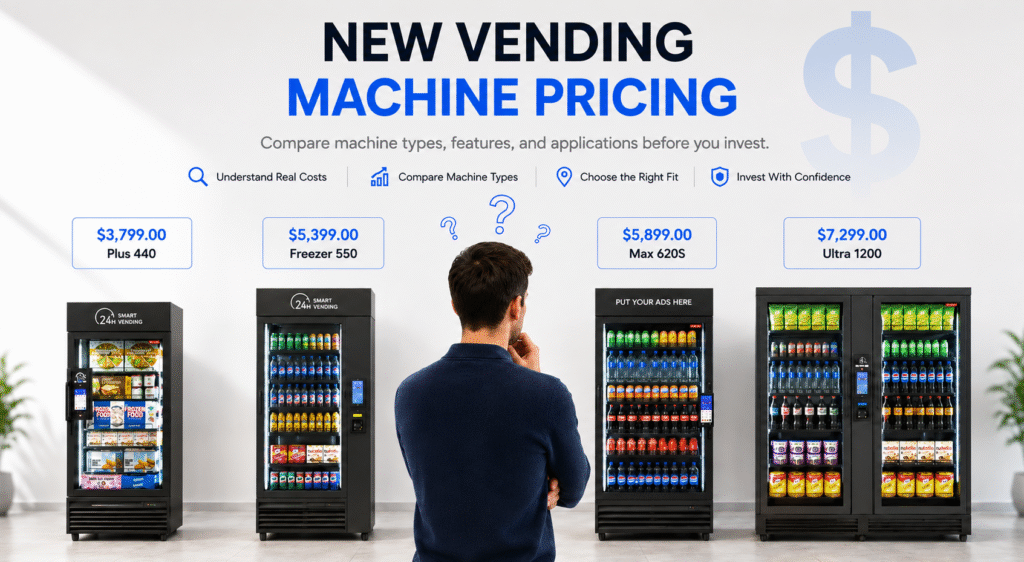
A Practical 2026 Price Guide for First-Time Buyers and Professional Operators
If you are asking how much is a brand new vending machine, you are probably looking for a clear price before deciding whether the business makes sense.
The quick answer is that a new commercial vending machine can cost anywhere from roughly $3,000 to more than $11,000, depending on the machine type, size, refrigeration system, payment technology, capacity, and level of automation.
Current U.S. dealer listings show compact smart coolers beginning at around $3,000, standard combo machines commonly priced between about $4,000 and $8,500, and larger cold-food or frozen machines reaching $10,000 or more.
But the price tag alone does not tell you whether a machine is affordable.
A $4,000 machine may be too expensive if it does not fit your location.
A $7,000 machine may be the better investment if it supports higher sales, reduces restocking trips, and operates reliably for years.
That is why experienced operators do not compare new vending machines only by purchase price.
They compare what each machine is designed to do.
Quick Answer: What Does a New Vending Machine Cost?
Here is a practical overview of typical new-machine price ranges in the U.S. market:
Machine type | Typical new price range | Common use |
|---|---|---|
Compact smart cooler | $3,000–$4,500 | Small offices, apartments, gyms |
Standard snack or drink machine | $4,000–$7,000 | Offices, schools, workplaces |
Snack-and-drink combo machine | $4,500–$9,000 | Gyms, laundromats, retail locations |
Large food-and-drink machine | $7,000–$11,000+ | Factories, hospitals, campuses |
Frozen vending machine | $5,000–$12,000+ | Ice cream, frozen meals, desserts |
AI grab-and-go machine | $3,000–$10,000+ | Smart retail and unattended stores |
These ranges are not fixed quotations. Dealer pricing can change based on configuration, promotions, payment hardware, freight, custom branding, and installation requirements.
For example, one U.S. equipment dealer currently lists compact smart coolers at about $3,095, standard smart coolers at approximately $4,395, and larger models near $6,895. On the same dealer site, new combo vending machines range from around $3,595 to more than $10,000, depending on size and delivery technology. (www.hahavending.ai)
The important point is simple:
There is no single price for a brand-new vending machine because there is no single type of vending machine.
Why Can Two New Machines Have Very Different Prices?
Two vending machines may look similar in a product photo but operate very differently.
The cabinet is only the visible part.
The internal systems usually determine the price.
1. Machine Size and Capacity
Larger machines require more materials, more shelving, larger cooling systems, and more floor space.
They also hold more inventory.
That can be valuable in a busy factory or campus, where a small machine may sell out quickly.
But larger capacity is not automatically better.
In a small office, a high-capacity machine may simply tie up more money in equipment and unsold products.
The right question is not:
“Which machine holds the most?”
It is:
“How much capacity does this location actually need?”
2. Refrigeration and Temperature Control
A machine designed only for packaged snacks generally costs less than one built for cold beverages, fresh food, or frozen products.
Refrigerated machines need:
- Compressors
- Insulation
- Temperature controls
- Ventilation
- Condensation management
- Safety monitoring
Frozen vending machines require even stronger systems to maintain stable temperatures.
This is one reason a frozen-food machine may cost considerably more than a basic snack machine.
3. Payment Technology
A basic machine may be sold without a card reader or contactless payment system.
A fully equipped machine may support:
- Credit and debit cards
- Apple Pay
- Google Pay
- Mobile wallets
- QR-code payments
- Remote transaction reporting
Cashless payment is no longer a minor feature in many locations.
It can directly affect whether customers use the machine.
However, buyers should confirm whether the card reader is included in the listed price or sold as an additional option.
4. Traditional Dispensing vs. AI Checkout
A traditional machine usually follows this process:
Select → Pay → Dispense
An AI-powered machine may work like this:
Tap or scan → Open → Take products → Close → Automatic checkout
The second format usually requires cameras, sensors, recognition software, connected payment systems, and a management platform.
Those features increase the upfront price, but they can also support:
- More flexible product placement
- Multiple-item purchases
- Remote inventory visibility
- Faster checkout
- Easier multi-location management
The value depends on how the machine will be used.
A small snack location may not need AI checkout.
A busy grab-and-go location may benefit from it.
How Much Is a Brand New Vending Machine for Your Location?
The most accurate price depends on the location before it depends on the machine.
A small office with 40 employees has different needs from a factory with 500 workers.
A gym may mainly sell water, sports drinks, and protein products.
An apartment building may need drinks, snacks, frozen meals, and daily essentials.
A hospital or university may require larger capacity and more frequent transactions.
Before comparing quotes, define four things:
- Who will use the machine?
- What products will it sell?
- How much daily traffic is expected?
- How often can it be restocked?
Once those answers are clear, the relevant price range becomes much easier to identify.
A new vending machine should not be purchased simply because it fits the budget.
It should be purchased because it fits the business.
What Else Do You Pay for Besides the Machine?
When people compare prices, they often focus on one number—the purchase price.
In reality, the cost of owning a brand-new vending machine goes well beyond the equipment itself.
Understanding these additional expenses helps you compare quotes more accurately and avoid surprises after installation.
Shipping and Delivery
A vending machine is large, heavy equipment. Shipping costs vary depending on:
- Delivery distance
- Warehouse location
- Whether liftgate service is required
- Indoor placement or curbside delivery
- Stairs, elevators, or other access limitations
A machine with a lower selling price may end up costing more if transportation fees are significantly higher.
Always ask suppliers whether shipping is included in the quotation.
Installation and Setup
Some machines are nearly ready to operate after delivery, while others require additional setup before they can begin generating revenue.
Depending on the supplier, setup may include:
- Machine configuration
- Payment system activation
- Software registration
- Network connection
- Initial testing
- Staff training
Some vendors include these services in the purchase price, while others charge separately.
Before making a decision, ask exactly what is included—not just what the machine costs.
Cashless Payment Services
Today’s consumers increasingly expect to pay with credit cards, mobile wallets, or contactless payment methods.
If your vending machine accepts only cash, you may lose sales from customers who rarely carry bills or coins.
Many operators should consider the following ongoing costs:
- Payment processing fees
- POS service fees
- SIM or connectivity fees
- Software subscriptions
These monthly expenses are often modest compared with the convenience they provide, but they should still be included when estimating the total cost of ownership.
Initial Inventory
A vending machine cannot generate revenue until it is stocked.
Your first inventory purchase is another startup expense that new operators sometimes underestimate.
The amount depends on:
- Machine capacity
- Product category
- Number of product selections
- Expected customer traffic
For example:
- A snack machine may require chips, cookies, candy, and protein bars.
- A beverage machine may need bottled water, soft drinks, energy drinks, juice, and ready-to-drink coffee.
- A frozen vending machine requires frozen meals, desserts, or ice cream.
Choosing the right products is just as important as choosing the right machine.
A fully stocked machine filled with slow-moving products ties up capital without generating revenue.
The Cheapest Machine Isn’t Always the Cheapest Business
One of the biggest mistakes first-time buyers make is comparing vending machines the same way they compare televisions or refrigerators.
The lowest purchase price rarely tells the whole story.
Imagine two operators.
The first buys a machine for $3,500 because it appears to be the cheapest option.
The second spends $5,500 on a machine with remote inventory management, cashless payment, and greater capacity.
At first, the first buyer appears to save $2,000.
Several months later, however, the situation looks different.
The smaller machine sells out more frequently.
Popular products remain unavailable until the next refill.
The owner has to visit the location more often to check inventory manually.
Meanwhile, the second machine requires fewer restocking trips, supports higher sales during busy periods, and allows inventory to be monitored remotely.
Although it cost more upfront, it may reduce labor, minimize missed sales, and improve overall operating efficiency.
The lesson is straightforward:
Purchase price is only one part of the investment.
Long-term operating costs—and the revenue the machine helps generate—often have a much greater impact on profitability.
New vs. Used: Which Offers Better Value?
Many entrepreneurs also ask whether they should buy a brand-new vending machine or a used one.
The answer depends on your business goals.
A used machine may be appropriate if:
- You have a limited startup budget.
- You are testing a single location.
- You are comfortable handling repairs.
- Modern payment technology is not a priority.
A brand-new vending machine may be the better choice if:
- You want manufacturer warranty coverage.
- You need reliable daily operation.
- Cashless payment is essential.
- You expect to expand to multiple locations.
- Remote management will save time and labor.
For businesses planning long-term growth, reliability is often worth more than the initial savings of purchasing used equipment.
The goal is not simply to spend less today.
The goal is to build a vending business that continues generating revenue for years.
How to Choose the Right Brand-New Vending Machine
After comparing prices, many buyers ask the same question:
“Which vending machine should I actually buy?”
The answer depends less on your budget and more on your business model.
A machine that performs well in a manufacturing plant may not be the best choice for a small office or apartment building. Instead of looking for the “best” machine, focus on finding the one that matches your location, products, and expected customer traffic.
Here are a few general recommendations.
For Small Offices and Apartment Buildings
If your location serves fewer than 100 people per day, a compact refrigerated machine or a standard snack-and-drink combo machine is often sufficient.
These machines require less floor space, lower upfront investment, and are generally easier to restock.
Typical products include:
- Bottled water
- Soft drinks
- Chips
- Candy
- Healthy snacks
- Ready-to-drink coffee
For many first-time operators, this is the easiest way to enter the vending business while keeping investment under control.
For Gyms and Fitness Centers
Fitness locations have a different customer profile.
Instead of traditional snacks, customers are more likely to purchase:
- Sports drinks
- Protein shakes
- Energy drinks
- Protein bars
- Healthy snacks
- Recovery beverages
A refrigerated machine with flexible shelving is usually the better choice, allowing operators to adjust product layouts as demand changes.
For Factories, Warehouses, and Large Workplaces
High-traffic locations require machines that can support continuous sales throughout the day.
Key priorities include:
- Large capacity
- Reliable refrigeration
- Cashless payment
- Remote inventory management
- Fast restocking
Machines that reduce refill frequency can significantly lower operating costs while improving product availability during busy shifts.
For Fresh Food and Frozen Products
If you plan to sell sandwiches, salads, frozen meals, desserts, or ice cream, you’ll need equipment designed for temperature-sensitive products.
These machines generally cost more than standard snack or beverage models because they require more advanced refrigeration systems and temperature control.
However, they also allow operators to offer higher-value products that can increase average transaction value.
Is an AI Vending Machine Worth the Extra Cost?
As smart retail technology becomes more common, many buyers compare traditional vending machines with AI-powered grab-and-go solutions.
AI vending machines typically cost more because they combine hardware with intelligent software, cameras, sensors, and automated checkout technology.
Instead of selecting products one by one, customers simply:
- Unlock the door
- Take what they want
- Close the door
The system automatically identifies the selected items and processes payment.
For locations with a wide variety of products, this shopping experience feels more natural than traditional vending.
AI technology can also provide operational advantages such as:
- Real-time inventory visibility
- Remote machine management
- Flexible product placement
- Automatic sales reporting
- Easier management across multiple locations
For operators planning to scale their business, these features can save time and improve efficiency over the long term.
Of course, AI is not necessary for every location.
If you’re operating a single low-traffic machine, a traditional vending machine may meet your needs perfectly.
The right choice depends on your business objectives—not simply on the latest technology.
Final Thoughts: How Much Is a Brand New Vending Machine?
So, how much is a brand new vending machine?
The answer is not a single number.
Most new commercial vending machines fall somewhere between $3,000 and $11,000+, with the final price determined by factors such as machine size, refrigeration, payment technology, capacity, and automation.
Before making a purchase, look beyond the equipment price alone.
Consider the total investment, including shipping, installation, payment systems, software, inventory, and long-term operating costs.
More importantly, choose a machine that matches your location and business goals rather than simply selecting the lowest-priced option.
A well-chosen vending machine can continue generating revenue for years, making it one of the most scalable and accessible retail businesses for entrepreneurs and professional operators alike.
Ready to Find the Right Vending Machine?
If you’re still deciding how much is a brand new vending machine for your specific business, the best next step is to compare solutions based on your location, product mix, and expected sales volume—not just the sticker price.
Ready to find the right vending machine for your business?
Every location is different, and so is the ideal vending solution. Whether you’re comparing machine types, estimating startup costs, or planning your first deployment, getting expert advice can help you avoid costly mistakes.
Talk to a vending specialist today and get personalized recommendations based on your location, products, and business goals.